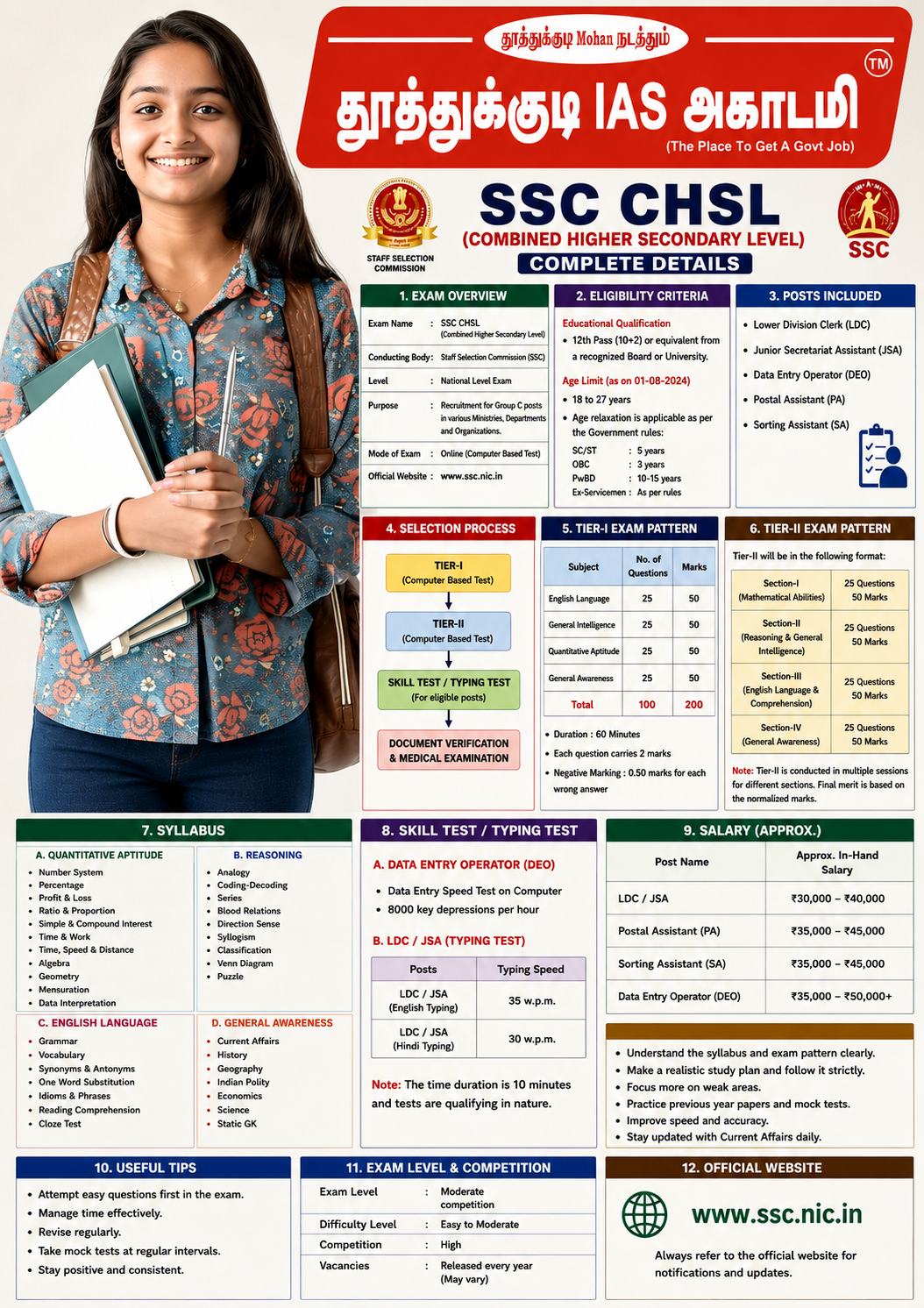
SSC CHSL
Program Overview
The SSC exam syllabus and paper pattern for the Combined Higher Secondary Level (CHSL) is mentioned in this section.
The SSC CHSL Exam will consist of the following Pattern:
Computer-Based Examination (Tier-I )
Descriptive Paper (Tier-II )
Skill Test/ Typing Test (Tier-III )
The SSC Exam pattern for CHSL- Tier-I
Part I
Subject : English Language (Basic Knowledge)
No of questions : 50
Total Marks : 50
Part II
Subject : General Intelligence
No of questions : 50
Total Marks : 50
Part III
Quantitative Aptitude(Basic Arithmetic Skill)/ SSC maths syllabus
No of questions : 50
Total Marks : 50
Part IV
Subject : General Awareness
No of questions : 50
Total Marks : 50
Duration : 60 Minutes (80 Minutes for PwD candidates
The SSC Exam pattern for CHSL- Tier II
Mode of Exam : Pen and Paper mode
Scheme of Exam : Descriptive Paper in Hindi/English
(Writing of Essays, Precis, Applications, etc.)
Maximum marks : 100
Time allowed :-
60 Minutes /Reserved candidates - 80 Minutes
The SSC Exam pattern for CHSL- Tier III
Category : Data Entry Skill test
Post : Skill Test for Data Entry Operator
Exam description:
Data Entry Speed of 8,000 (eight thousand) Key Depressions on Computer.
Category : Data Entry Skill test
Post : Data Entry Operator in the Office of the Comptroller and Auditor General of India (C&AG)
Exam description : Speed of 15000 key depressions on Computer‟
Duration : 60 minutes/80 minutes for reserved candidates
Category : Typing Test
Post : LDC/ JSA and Postal Assistant/ Sorting Assistant
Exam description :
English typing speed- 35 words per minute OR
Hindi typing speed- 30 words per minute
Duration : 60 minutes/80 minutes for reserved candidates
Syllabus & Core Modules
SSC GENERAL STUDIES
In SSC (Staff Selection Commission) exams, General Studies (GS)—officially referred to as General Awareness—is a core paper that evaluates a candidate's broad, day-to-day knowledge of the world and their awareness of socio-political, economic, and historical events.
SSC MATHS
The SSC (Staff Selection Commission) Maths syllabus—officially known as Quantitative Aptitude or Mathematical Abilities—is a core subject for exams like SSC CGL, CHSL, and MTS. It is divided into two main categories: Arithmetic (basic computation) and Advanced Maths (algebra, geometry, and trigonometry) The syllabus is comprehensively tested across Tier 1 and Tier 2 of the exams: 1. Arithmetic Number System & Simplification: LCM, HCF, decimals, fractions, and divisibility rules. Percentages & Profit & Loss: Discounts, markups, and successives. Ratio, Proportion, & Partnership: Mixture and alligation, ages, and averages. Time & Distance: Relative speed, train problems, and boats & streams. Time & Work: Pipes and cisterns, and work efficiency. Interest: Simple Interest and Compound Interest (SI & CI) 2. Advanced Maths Algebra: Basic algebraic identities, linear equations, and quadratic equations. Geometry: Lines, angles, triangles, polygons, and circles (chords, tangents). Mensuration: Area, surface area, and volume of 2D and 3D figures (cubes, cylinders, spheres, cones). Trigonometry: Ratios, standard identities, and heights & distances. Data Interpretation (DI): Tables, bar graphs, pie charts, and line graphs. Statistics & Probability: Mean, median, mode, and basic probability (mostly tested in Tier 2) Exam Format & Weightage Tier 1: Typically 25 questions worth 50 marks. The questions primarily test foundational arithmetic and basic formulas. Tier 2: 30 questions (worth 90 marks) in the Mathematical Abilities section. The difficulty is significantly higher, requiring deep application of geometry, advanced algebra, and complex DI
SSC ENGLISH
The SSC English section is a foundational pillar for recruitment exams like SSC CGL, CHSL, MTS, and CPO. It tests a candidate’s vocabulary, grammar, reading comprehension, and verbal ability. The syllabus is broadly divided into three main components
SSC REASONING
SSC Reasoning refers to the "General Intelligence and Reasoning" section featured in competitive examinations conducted by the Staff Selection Commission (SSC) in India (such as SSC CGL, CHSL, and MTS). It measures a candidate's analytical thinking, logical deduction, and problem-solving abilities under time constraints The section is broadly divided into two main categories: Verbal Reasoning and Non-Verbal Reasoning
Program Highlights
Enroll Directly Online
Pay online to unlock this course immediately and start learning.
Purchase Course NowRequest Admissions
Secure your enrollment slot
Direct Branch Contact