SSC MTS
Program Overview
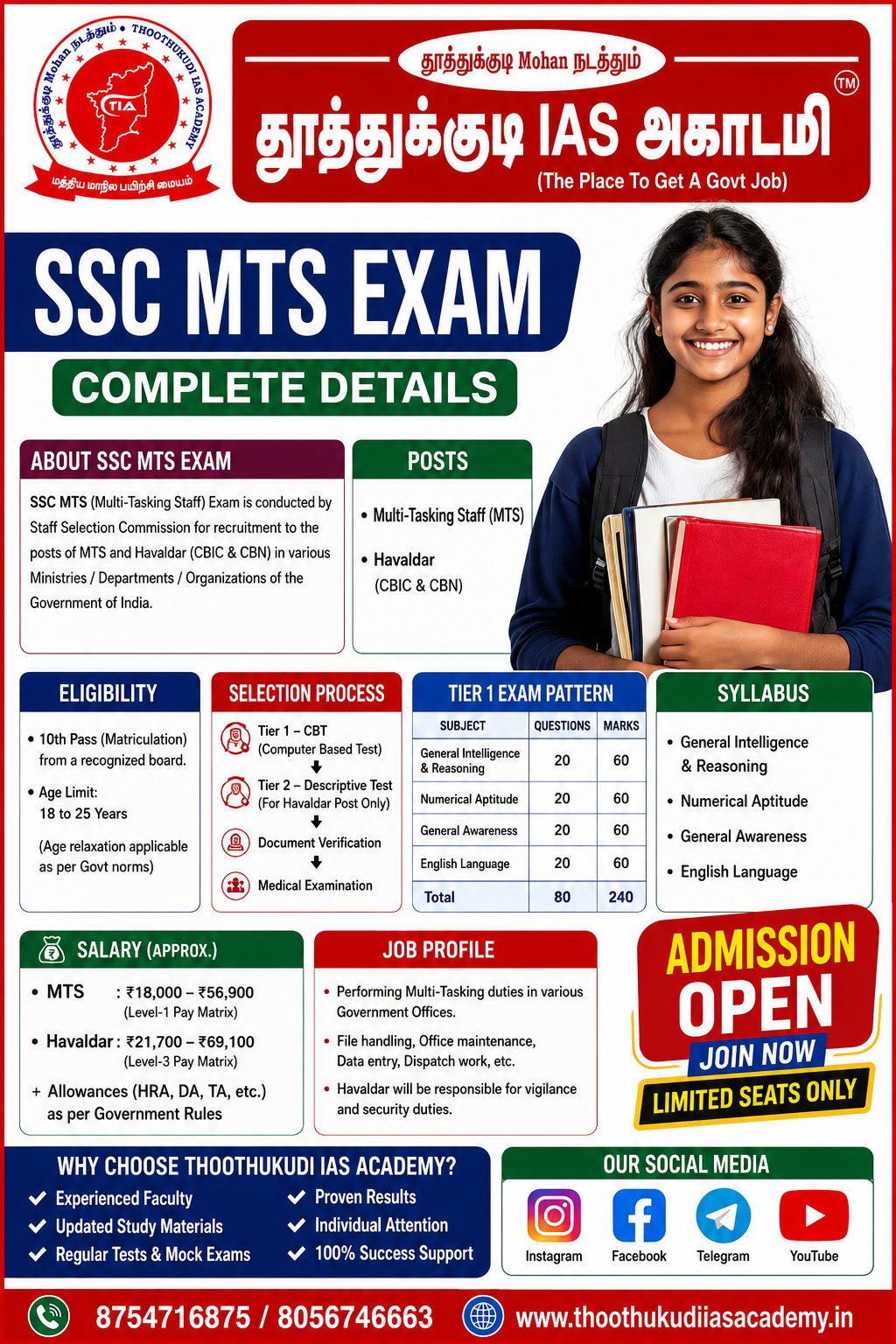
SSC MTS (Multi-Tasking Staff) Exam is conducted by the Staff Selection Commission for recruitment to Central Government offices. The main posts are:
1. Multi-Tasking Staff (MTS)
Work includes:
Office Assistant
Peon
Daftary
Jamadar
Junior Gestetner Operator
Chowkidar
Safaiwala
Mali (Gardener)
Dispatch Rider (Department-wise)
Duties:
File movement
Photocopying
Record maintenance
Office cleaning
Carrying documents
Assisting officers
2. Havaldar (CBIC)
CBIC – Central Board of Indirect Taxes & Customs
Duties:
Office assistance
Security duties
Field work
Customs and GST department support
Selection:
CBT Exam
PET/PST Physical Test
3. Havaldar (CBN)
CBN – Central Bureau of Narcotics
Duties:
Field inspections
Security and surveillance
Department support work
Selection:
CBT Exam
PET/PST Physical Test
SSC MTS Eligibility
Qualification: 10th Pass (Matriculation)
Age: 18–25 Years (MTS)
Age: 18–27 Years (Havaldar)
Age Relaxation as per Government Rules
SSC MTS Salary
Post Salary
MTS ₹18,000 – ₹56,900
Havaldar ₹21,700 – ₹69,100
Plus:
DA
HRA
TA
Medical Benefits
Pension Benefits (as applicable)
SSC MTS Syllabus
* General Intelligence & Reasoning
* Numerical Aptitude
* General Awareness
* English Language
SSC MTS Selection Process
1. Computer Based Test (CBT)
2. PET/PST (Only for Havaldar)
3. Document Verification
4. Final Selection
SSC MTS Posts Summary
Multi-Tasking Staff (MTS)
Havaldar (CBIC)
Havaldar (CBN)
Syllabus & Core Modules
SSC ENGLISH
The SSC English section is a foundational pillar for recruitment exams like SSC CGL, CHSL, MTS, and CPO. It tests a candidate’s vocabulary, grammar, reading comprehension, and verbal ability. The syllabus is broadly divided into three main components
SSC GENERAL STUDIES
In SSC (Staff Selection Commission) exams, General Studies (GS)—officially referred to as General Awareness—is a core paper that evaluates a candidate's broad, day-to-day knowledge of the world and their awareness of socio-political, economic, and historical events.
SSC MATHS
The SSC (Staff Selection Commission) Maths syllabus—officially known as Quantitative Aptitude or Mathematical Abilities—is a core subject for exams like SSC CGL, CHSL, and MTS. It is divided into two main categories: Arithmetic (basic computation) and Advanced Maths (algebra, geometry, and trigonometry) The syllabus is comprehensively tested across Tier 1 and Tier 2 of the exams: 1. Arithmetic Number System & Simplification: LCM, HCF, decimals, fractions, and divisibility rules. Percentages & Profit & Loss: Discounts, markups, and successives. Ratio, Proportion, & Partnership: Mixture and alligation, ages, and averages. Time & Distance: Relative speed, train problems, and boats & streams. Time & Work: Pipes and cisterns, and work efficiency. Interest: Simple Interest and Compound Interest (SI & CI) 2. Advanced Maths Algebra: Basic algebraic identities, linear equations, and quadratic equations. Geometry: Lines, angles, triangles, polygons, and circles (chords, tangents). Mensuration: Area, surface area, and volume of 2D and 3D figures (cubes, cylinders, spheres, cones). Trigonometry: Ratios, standard identities, and heights & distances. Data Interpretation (DI): Tables, bar graphs, pie charts, and line graphs. Statistics & Probability: Mean, median, mode, and basic probability (mostly tested in Tier 2) Exam Format & Weightage Tier 1: Typically 25 questions worth 50 marks. The questions primarily test foundational arithmetic and basic formulas. Tier 2: 30 questions (worth 90 marks) in the Mathematical Abilities section. The difficulty is significantly higher, requiring deep application of geometry, advanced algebra, and complex DI
SSC REASONING
SSC Reasoning refers to the "General Intelligence and Reasoning" section featured in competitive examinations conducted by the Staff Selection Commission (SSC) in India (such as SSC CGL, CHSL, and MTS). It measures a candidate's analytical thinking, logical deduction, and problem-solving abilities under time constraints The section is broadly divided into two main categories: Verbal Reasoning and Non-Verbal Reasoning
Program Highlights
Enroll Directly Online
Pay online to unlock this course immediately and start learning.
Purchase Course NowRequest Admissions
Secure your enrollment slot
Direct Branch Contact