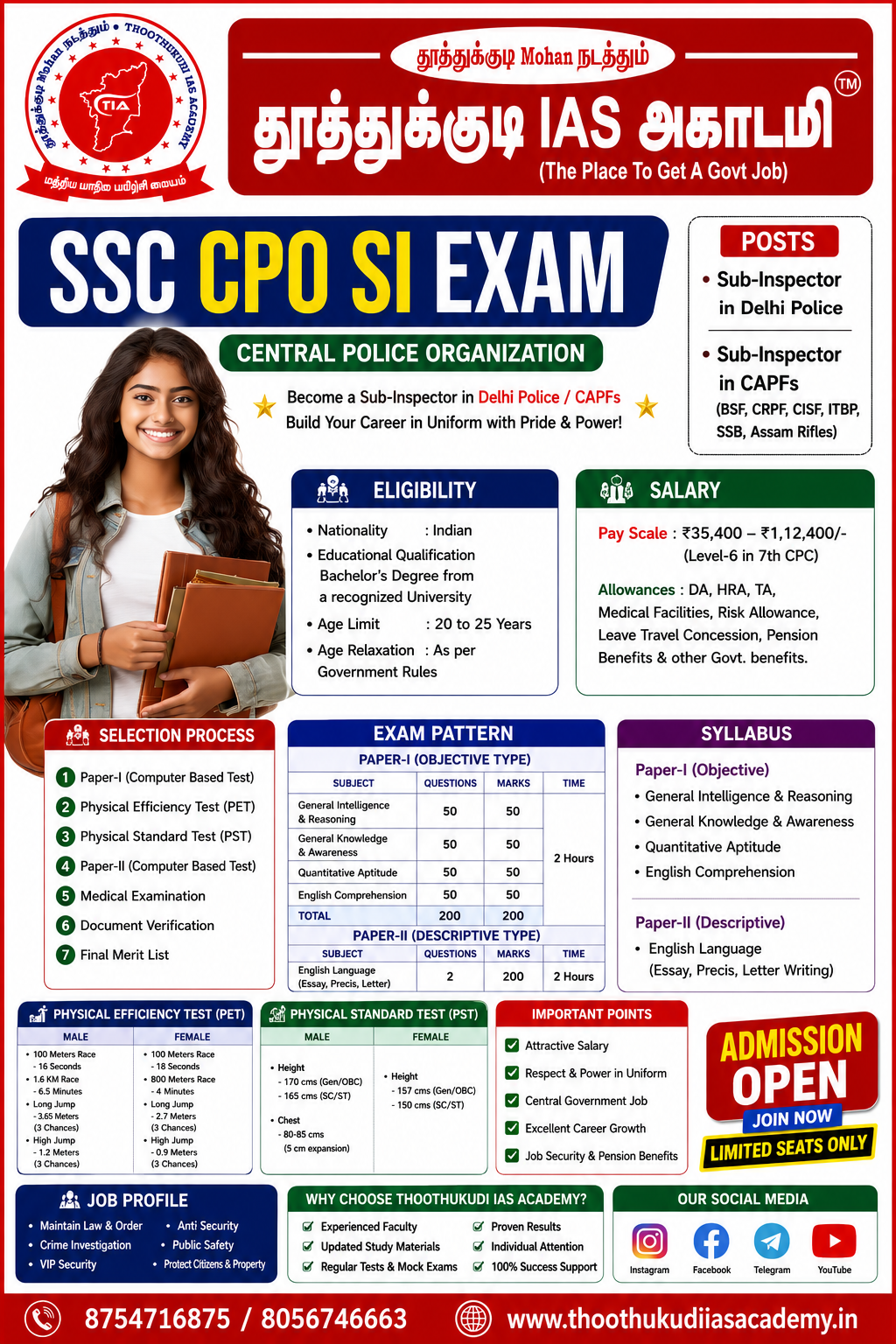
SSC CPO SI
Program Overview
What is SSC CPO?
SSC CPO (Staff Selection Commission – Central Police Organization) exam is conducted for recruitment of Sub-Inspectors (SI) in:
Delhi Police
CAPFs (Central Armed Police Forces)
BSF
CRPF
CISF
ITBP
SSB
Posts Recruited
1. Sub-Inspector (Executive) in Delhi Police
2. Sub-Inspector in CAPFs
BSF
CRPF
CISF
ITBP
SSB
Eligibility Criteria
Educational Qualification
Bachelor's Degree from a recognized University.
Age Limit
20 to 25 Years
Age relaxation as per Government rules.
Salary
Pay Level
Level-6 Pay Matrix
Salary Range
₹35,400 – ₹1,12,400 per month
Additional Benefits
DA
HRA
TA
Medical Facilities
Leave Travel Concession
Pension Benefits
Risk Allowance (Force-wise)
Selection Process
Stage 1 – Paper I (Computer Based Test)
Stage 2 – Physical Standard Test (PST)
Stage 3 – Physical Endurance Test (PET)
Stage 4 – Paper II (English Language)
Stage 5 – Medical Examination
Stage 6 – Document Verification
Final merit is prepared based on performance in written examinations after qualifying physical and medical tests.
SSC CPO Paper-I Exam Pattern
Subject Questions Marks
General Intelligence & Reasoning 50 50
General Knowledge & Awareness 50 50
Quantitative Aptitude 50 50
English Comprehension 50 50
Total 200 200
Duration: 2 Hours
Negative Marking: 0.25 Mark per wrong answer
SSC CPO Paper-II Exam Pattern
Subject Questions Marks
English Language & Comprehension 200 200
Duration: 2 Hours
Mode: Online CBT
Physical Efficiency Test (PET)
Male Candidates
100 Meter Race – 16 Seconds
1.6 Km Race – 6.5 Minutes
Long Jump – 3.65 Meters
High Jump – 1.2 Meters
Shot Put (16 lbs) – 4.5 Meters
Female Candidates
100 Meter Race – 18 Seconds
800 Meter Race – 4 Minutes
Long Jump – 2.7 Meters
High Jump – 0.9 Meters
Physical Standard Test (PST)
Male
Height: 170 cm
Chest: 80–85 cm
Female
Height: 157 cm
Chest Measurement: Not Applicable
(Relaxations available for reserved categories.)
SSC CPO Syllabus
General Intelligence & Reasoning
Analogies
Coding-Decoding
Blood Relations
Direction Test
Series
Classification
General Knowledge & Awareness
History
Geography
Polity
Economy
Science
Current Affairs
Quantitative Aptitude
Percentage
Ratio & Proportion
Profit & Loss
Average
Time & Work
Mensuration
English Comprehension
Grammar
Vocabulary
Synonyms & Antonyms
Reading Comprehension
Paper-II English
Grammar
Error Spotting
Vocabulary
Comprehension
Sentence Improvement
Job Profile
Delhi Police SI
Crime Investigation
Law & Order Maintenance
Public Safety
VIP Security
CAPF SI
Border Security
Internal Security
Anti-Terror Operations
Intelligence Collection
National Security Duties
Why Choose SSC CPO SI?
Graduate Level Government Job
Uniform Service & Prestige
Attractive Salary
Fast Promotion Opportunities
Central Government Benefits
Pension & Job Security
Opportunity to Serve the Nation
Quick Summary
Exam Name: SSC CPO SI
Qualification: Any Degree
Age Limit: 20–25 Years
Posts: SI in Delhi Police & CAPFs
Salary: ₹35,400 – ₹1,12,400
Selection: Paper-I → PST/PET → Paper-II → Medical → DV
Job Location: Across India
Syllabus & Core Modules
SSC ENGLISH
The SSC English section is a foundational pillar for recruitment exams like SSC CGL, CHSL, MTS, and CPO. It tests a candidate’s vocabulary, grammar, reading comprehension, and verbal ability. The syllabus is broadly divided into three main components
SSC GENERAL STUDIES
In SSC (Staff Selection Commission) exams, General Studies (GS)—officially referred to as General Awareness—is a core paper that evaluates a candidate's broad, day-to-day knowledge of the world and their awareness of socio-political, economic, and historical events.
SSC MATHS
The SSC (Staff Selection Commission) Maths syllabus—officially known as Quantitative Aptitude or Mathematical Abilities—is a core subject for exams like SSC CGL, CHSL, and MTS. It is divided into two main categories: Arithmetic (basic computation) and Advanced Maths (algebra, geometry, and trigonometry) The syllabus is comprehensively tested across Tier 1 and Tier 2 of the exams: 1. Arithmetic Number System & Simplification: LCM, HCF, decimals, fractions, and divisibility rules. Percentages & Profit & Loss: Discounts, markups, and successives. Ratio, Proportion, & Partnership: Mixture and alligation, ages, and averages. Time & Distance: Relative speed, train problems, and boats & streams. Time & Work: Pipes and cisterns, and work efficiency. Interest: Simple Interest and Compound Interest (SI & CI) 2. Advanced Maths Algebra: Basic algebraic identities, linear equations, and quadratic equations. Geometry: Lines, angles, triangles, polygons, and circles (chords, tangents). Mensuration: Area, surface area, and volume of 2D and 3D figures (cubes, cylinders, spheres, cones). Trigonometry: Ratios, standard identities, and heights & distances. Data Interpretation (DI): Tables, bar graphs, pie charts, and line graphs. Statistics & Probability: Mean, median, mode, and basic probability (mostly tested in Tier 2) Exam Format & Weightage Tier 1: Typically 25 questions worth 50 marks. The questions primarily test foundational arithmetic and basic formulas. Tier 2: 30 questions (worth 90 marks) in the Mathematical Abilities section. The difficulty is significantly higher, requiring deep application of geometry, advanced algebra, and complex DI
SSC REASONING
SSC Reasoning refers to the "General Intelligence and Reasoning" section featured in competitive examinations conducted by the Staff Selection Commission (SSC) in India (such as SSC CGL, CHSL, and MTS). It measures a candidate's analytical thinking, logical deduction, and problem-solving abilities under time constraints The section is broadly divided into two main categories: Verbal Reasoning and Non-Verbal Reasoning
Program Highlights
Enroll Directly Online
Pay online to unlock this course immediately and start learning.
Purchase Course NowRequest Admissions
Secure your enrollment slot
Direct Branch Contact